



Becker’s mole, first described by Samuel William Becker in 1948, is a skin lesion caused by an overgrowth of the epidermis. It can be congenital or acquired and usually appears as tan to brown, hairy patches on the shoulders, chest, or back. In many cases, Becker’s mole is asymptomatic and only causes cosmetic problems.
In this article, we report a case of Becker’s nevus in a 19-year-old female patient who was initially treated with Q-switched laser, but this treatment was ineffective. Therefore, dermabrasion with sterile sandpaper was chosen for treatment, which had a very successful outcome and the lesion disappeared completely, without any complications.
This content was compiled by Dr. Reza Moeini and his colleagues and published on the Wiley Online Library website.
Case presentation
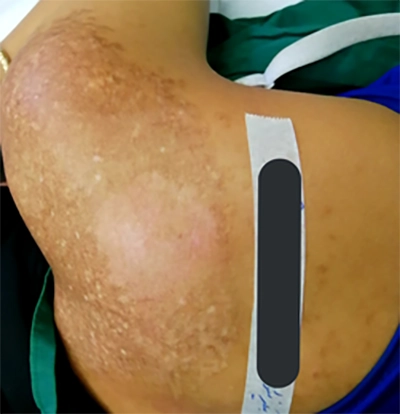
The patient was a healthy 19-year-old woman who had developed an irregular discoloration on her right shoulder and scapula since the age of 15. The lesion had grown larger over time and had reached 20 × 20 cm in size when she visited the dermatology department (Figure 1). The patient had no complaints of itching, bleeding, or scaling, and she denied any systemic disease or medication. The patient was not hirsutistic.
After examination, a diagnosis of Becker’s nevus was made, which was confirmed by biopsy. No findings indicating the presence of other diseases were observed. After re-evaluation by another dermatologist, the definitive diagnosis was confirmed.
Initially, three sessions of Q-switched ruby laser treatment (694 nm, 5 J energy, 3 × 3 mm spot size) were performed, but no improvement was observed. Therefore, it was decided to use dermabrasion. In this method, after local anesthesia, a sterile 180-grit emery board was used to remove the epidermis and superficial dermis in a 10 × 10 cm area manually in circular patterns. Antibiotics including oral cephalexin and mupirocin ointment were prescribed to prevent infection.
After three months of follow-up, the lesion had completely resolved and no complications such as bleeding, infection, scarring, or skin discoloration were observed. The procedure was successful in one dermabrasion session and the lesion never recurred. After the selected area of the lesion had healed, the decision was made to use the same exact dermabrasion procedure for the entire lesion surface. The patient showed significant improvement in the lesion area after three months of follow-up (Figure 3).
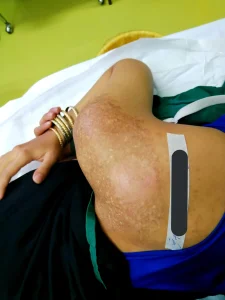
An intact mole on the patient’s shoulder.
Image of the initial condition of the lesion.
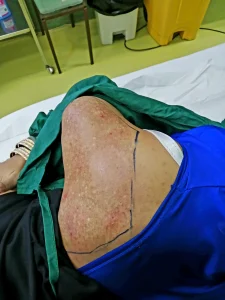
A 10 x 10 cm area that responded to a previous dermabrasion.
Image of the improvement of the area that underwent dermabrasion.
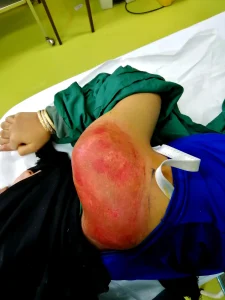
Dermabrasion of the entire lesion in the shoulder area.
Image of performing dermabrasion on a larger area.
Discussion
A virgin mole is often considered an asymptomatic skin discoloration that does not require initial treatment, but in some patients, the cosmetic burden of hyperpigmentation or hirsutism makes treatment necessary.
Various treatments have been proposed for virgin nevi. One of these methods is the Q-switched ruby laser, which is effective in treating hyperpigmentation, but the results are usually unstable and have a high risk of recurrence. In one study, the Er:YAG laser was found to be more effective than the Q-switched Nd:YAG laser, and the results of topical flutamide treatment for virgin nevi have also been reported.
In this patient, despite three sessions of Q-switched ruby laser treatment, no improvement was achieved, so the treatment was changed to dermabrasion. Dermabrasion is a skin rejuvenation procedure that removes the epidermis and helps the skin repair. This procedure was used to treat skin lesions long before the advent of lasers and is still considered an effective method of treating skin lesions today.
In this article, dermabrasion with sandpaper was used, which was a cost-effective and effective method for treating virgin moles. This method can produce good results, especially in patients who do not respond to laser therapy. In this particular case, the patient had no complications and the lesion completely disappeared after treatment.
Conclusion
Sandblasting dermabrasion is an effective and cost-effective method for treating virgin moles. It can be used as an alternative to more expensive treatments such as laser in patients who do not respond to laser. The results of this study suggest that sandblasting dermabrasion is a viable option for treating virgin moles.
To view the full article and related images, you can visit the link below: