



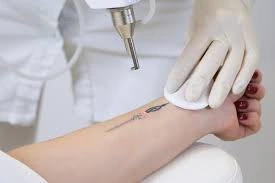
Important tips about laser tattoo removal
You may regret getting a tattoo after some time, what can you do in these situations? There are various methods for removing tattoos from the body, one of which is laser. There are a wide variety of laser devices in the world that are designed to remove all types of tattoos. In the following, we will discuss laser tattoo removal and its benefits, so stay with us until the end of the article for more guidance on the types of laser tattoo removal devices.
Why is it hard to remove tattoos?
The dyes used in tattoos penetrate the dermis layer of the skin with their hard, fibrous structure and settle there. Therefore, it is not possible to remove these dyes without affecting the surrounding tissue.
How is laser tattoo removal done?
If you have had IPL treatment for your skin or hair problems, you are more familiar with laser tattoo removal. A laser tattoo removal machine produces short bursts of light at different wavelengths. When these light waves are directed at the tattoo, they penetrate the skin and are absorbed by the ink. The laser light waves break the ink into smaller particles that are gradually eliminated by the body and immune system. The process of laser tattoo removal is a gradual one.
How to remove a tattoo with a Q-switch laser
The Q-switched (q) technique allows the creation of short-duration (from a few nanoseconds to a few tens of nanoseconds) and high-power (from a few megawatts to several hundred megawatts) laser pulses. The creation of laser pulses is achieved by sequentially switching on the tattooed body parts, which converges a beam of monochromatic beams towards the desired point and sends the generated pulses to that point in an oscillating manner.
With this method, much more intense lasers can be produced. In fact, by successive pumping, the energy of each laser pulse will be greater than before and the final energy can be reached. There are two types of switching with this method, if the switching is done quickly, we will have a very strong laser output. (A single very strong pulse) and if the switching is done slowly, the output will have several pulses with lower power.
Wavelength
The two types of pulse wavelengths produced by this device: 1064nm, 532nm correspond to dark blue and black. In addition to its excellent performance in removing dark tattoos, this device is also very effective in removing skin blemishes, local darkening, and burn and wound scars.
How Q-Switch Laser Works in Tattoo Removal
Its function is that the pulse created enters the skin and dissolves the tattoo pigments at different depths of the skin. In other words, it reacts with the colored particles and ultimately destroys the colored tissue in the dermis layer of the skin. These fine particles are eventually absorbed by the body. Some colored particles may remain deep in the dermis, but with this method, the visible surface layer of the epidermis is completely destroyed and becomes colorless. In some cases, tattoos with deep colored layers or very old tattoos can be difficult to completely remove.
The advantage of tattoo removal with Q-switch laser
In addition to removing pigmented tissue, this device stimulates your skin to produce collagen and is effective in eliminating redness, reducing inflammation, and eliminating open pores. Acne patients are very satisfied with the performance of this device.
Number of sessions
Multiple laser sessions are often needed to remove a tattoo, especially when the tattoo is large and covers a large area of skin. However, the color of the ink also plays a role in the tattoo removal process. The number of sessions will vary depending on how old the tattoo is or what materials were used.
Using different wavelengths
Different tattoo colors require different wavelengths of light because the amount of light absorbed by the ink varies. Yellow, green, and blue inks are usually the hardest to remove, while black and red are the easiest. The larger, more colorful, and more intricate the tattoo design, the more sessions it will take to remove it. Older laser tattoo removal machines and surgical tattoo removal machines can damage the skin, but laser tattoo removal is safer and less likely to cause permanent damage to the skin. Newer machines are more capable of completely removing the color of the tattoo. The Helios III is the latest Q Switch machine available.

Alternatives to laser tattoo removal
Other alternatives to laser to remove these colors are using surgery to remove the colored layer of skin or using sea salts, chemical or organic compounds to remove the colored layer of skin, which will cause very serious damage and irreversible complications.
Care before laser tattoo removal
Things that should be checked with the client before starting the laser include age, the cause of the tattoo, and specific illnesses, and there may be a need for a special diet that is recommended to the patient by a specialist. Because, as previously mentioned, professional and old tattoos require more effort to remove from the skin than simple amateur tattoos.
Care after laser tattoo removal
Immediately after laser tattoo removal, a special ointment is applied and covered, and the area should be kept clean. For 48 hours after laser removal, do not use any medications or products that irritate the skin, such as hydroquinone, peels, etc.
Follow all the recommendations given to you after your laser session .
- If a superficial wound occurs in the laser area, it usually disappears after 4 to 5 days. These wounds should not be picked at under any circumstances as this may cause permanent scarring.
- The client can shower the next day, but should never rub their tattoo with a tissue.
- For at least 6 weeks, the lasered area should be protected from exposure to sunlight and strong light (such as tanning beds) and sunscreen with an SPF of 30 or higher should be used.
Some of the side effects of using lasers:
- In general, a minimum of four weeks should be allowed between laser sessions to minimize side effects. A topical antiseptic can also be used to prevent infection.
- The most common chronic side effect of laser treatment is hypopigmentation (darkening). This risk is highest in people with dark skin treated with QSR or Oxanerite 4 lasers and increases with the number of treatment sessions per patient.
- Using this laser may cause white spots, very slight bleeding, and hemoglobin absorption. These effects last for seven to ten days and disappear.
- In some cases, when metals such as iron are used in tattoo materials, they may react with the laser and darken the tissue. To prevent this complication, in addition to determining the type of tattoo, a test should be performed on a very small spot of the area.