


Botox or microneedling? Which method is more effective in treating large facial pores?
Large facial pores are a common problem that many people struggle with and can negatively affect their beauty and self-confidence. You may have wondered: Botox or microneedling? Which is more effective in reducing large pores? In recent years, researchers and dermatologists have been searching for the best way to treat this problem. In this regard, a scientific study was published in the Journal of Cosmetic Dermatology in collaboration with Dr. Reza Moeini and his team of colleagues , which directly compared the two methods: Botox and microneedling with Botox. Below, we will review this article in simple language so that you know which method is more suitable for you.
Introduction
Large pores are a common problem, especially for people with oily or seborrhea skin. Not only do these pores make the skin look uneven, they can also lead to other problems, such as acne and excess oil. In the past, treatments such as topical creams, chemical peels, and lasers were used as treatments. However, these treatments were always limited in effectiveness and did not last long.
Recent advances in dermatology have introduced new methods. Intradermal Botox injections and microneedling combined with Botox are among these techniques, both of which have a positive effect on improving skin texture and reducing pores. Botox works by reducing sebum secretion and local paralysis of pilar muscles, while microneedling, in addition to creating microscopic channels for better drug penetration, stimulates collagen production and skin rejuvenation.
Method of conducting the study
This study was conducted in Isfahan and was designed as a randomized clinical trial. Thirty patients aged 25 to 60 years with large facial pores were included in the study.
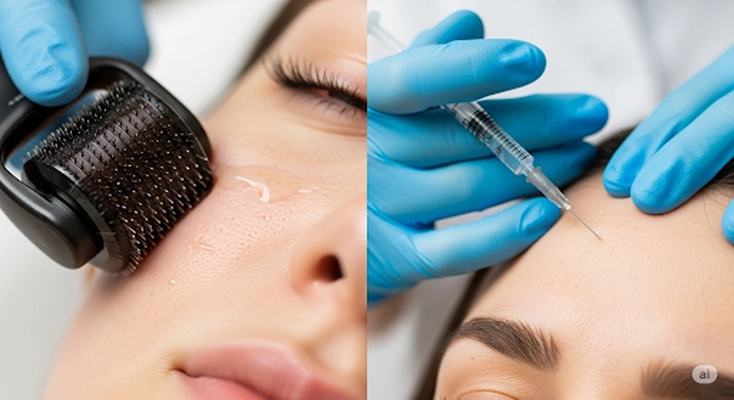
One side of the patients’ face was treated with direct intradermal Botox injections .
The other side was treated with microneedling along with Botox injections .
Doctors used local anesthesia for both procedures. Botox concentration: 100 units in 2.5 ml.
In the microneedling method, the depth of the needles was 3 to 3.5 mm, and after spot bleeding, Botox was injected.
In the intradermal method, injections were performed 1 cm apart in the dermis layer.
After treatment, patients were advised to avoid strenuous activity, direct sunlight, and taking anti-inflammatory medications.
Review criteria
To measure the results, the following were recorded:
Dermoscopy images before and one month after treatment.
Physical examination by doctors.
Patient satisfaction with Likert scale (from 1=very dissatisfied to 5=very satisfied).
Three dermatologists evaluated the results blindly. Data were analyzed using paired t-test and significance level was considered p<0.05.
Study results
 Of the 30 participating patients, 29 were female and 1 was male. The average age of the patients was 34.2 years. Most of them had oily or very oily skin.
The studies showed:
Dermoscopy and physical examination scores in the cheeks and nose did not differ significantly between the two methods.
The average patient satisfaction score was 3.5 on the intradermal side and 3.8 on the microneedling side; this difference was also not statistically significant.
Both methods resulted in a significant reduction in pore size.
Images and evidence
Dermoscopy images before and after treatment showed that both Botox and microneedling with Botox reduced pores and improved skin texture. The visual difference between the two methods was minor, and both were clinically effective.

Evaluation of dermoscopy scores and physical examination by dermatologists: LCD (left cheek dermoscopy), LCP (left cheek physical examination), LND (left nasal dermoscopy), LNP (left nasal physical examination), RCD (right cheek dermoscopy), RCP (right cheek physical examination), RND (right nasal dermoscopy), RNP (right nasal physical examination).

Dermoscopic photographs of the nasal area in a patient treated with microneedling combined with Botox, including (a) before polarized treatment, (b) after one month of polarized treatment, (c) before non-polarized treatment, and (d) after one month of non-polarized treatment.

Dermoscopic photographs of the cheek area in a patient treated with microneedling combined with Botox, including (a) before polarized treatment, (b) after one month of polarized treatment, (c) before non-polarized treatment, and (d) after one month of non-polarized treatment.

Dermoscopic photographs of the nasal area in a patient treated with mesotherapy combined with Botox, including (a) before polarized treatment, (b) after one month of polarized treatment, (c) before non-polarized treatment, and (d) after one month of non-polarized treatment.

Dermoscopic photographs of the cheek area in a patient treated with mesotherapy combined with Botox, including (a) before polarized treatment, (b) after one month of polarized treatment, (c) before non-polarized treatment, and (d) after one month of non-polarized treatment.
Discussion and analysis
This study showed that:
Botox helps shrink pores by reducing the activity of sebaceous glands and sebum secretion.
Microneedling increases the penetration of Botox by creating microchannels and, in addition, stimulates collagen production and skin rejuvenation.
Despite the differences in mechanism, in practice both methods had similar effectiveness. Therefore, the final choice of method depends more on the patient’s condition, skin type, pain tolerance, and individual preference.
Side effects
In the intradermal method: Mild swelling was observed in some patients, which resolved within 2 hours.
In the microneedling method: Slight redness occurred, which disappeared within 24 hours.
No cases of hyperpigmentation or serious complications were reported.
In the intradermal method: Mild swelling was observed in some patients, which resolved within 2 hours.
In the microneedling method: Slight redness occurred, which disappeared within 24 hours.
No cases of hyperpigmentation or serious complications were reported.
Research limitations
Relatively small sample size (30 people).
Short-term follow-up (one month).
The majority of patients were female, so the results may not be fully generalizable to men.
Relatively small sample size (30 people).
Short-term follow-up (one month).
The majority of patients were female, so the results may not be fully generalizable to men.
Final conclusion
A study conducted by Dr. Reza Moeini and colleagues shows that both intradermal Botox and microneedling combined with Botox are effective in reducing large facial pores and do not have a significant difference in terms of the final result. These findings allow dermatologists to choose the best method based on the patient’s condition and preferences.
Main source of the study
To read the full text of the article on the Wiley Online Library website, you can refer to the following link: Comparison of Intradermal Versus Microneedling-Assisted Botulinum A Toxin Injection for Enlarged Facial Pores – Journal of Cosmetic Dermatology
 This article has been published by Dr. Reza Moeini’s website to provide scientific and practical information on modern skin treatment methods to the audience.