



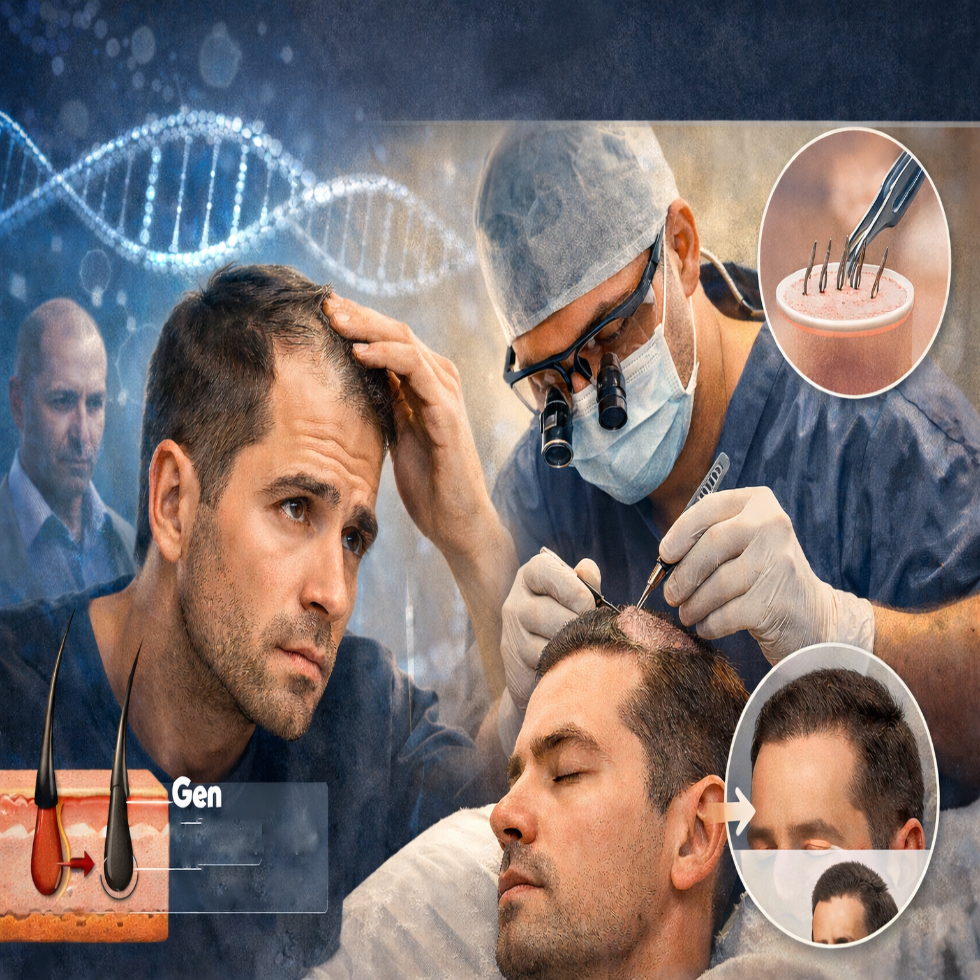
The clientele of hair and skin clinics consists of: Many people, upon seeing the first signs of hair loss, are looking for a definitive and permanent solution, and the question is often asked whether cosmetic surgery can treat genetic hair loss. The answer to this question requires a detailed understanding of the role of genetics in hair loss, the mechanism of this type of hair loss, as well as awareness of the capabilities and limitations of cosmetic surgery methods.
In this article from Dr. Reza Moeini’s website , we will comprehensively and scientifically examine what genetic hair loss is, why it occurs, how it differs from other types of hair loss, and to what extent cosmetic surgeries such as hair transplants can help treat or control it. We will also discuss the limitations, realistic expectations, and the role of non-surgical treatments alongside surgery.
What is genetic hair loss?
Genetic hair loss, medically known as androgenic alopecia, is a type of hair loss that is caused by hereditary and hormonal factors. In this type of hair loss, hair follicles become more sensitive to androgenic hormones, especially dihydrotestosterone (DHT). This sensitivity causes the follicles to gradually shrink, the hair strands to thin, and eventually stop growing.
Genetic hair loss usually has a distinct pattern. In men, it is often seen as a receding hairline in the forehead and thinning at the crown, while in women, it is more likely to manifest as diffuse thinning in the central region of the head, with the hairline usually preserved.
The role of genetics in hair loss
Genes play a major role in determining the sensitivity of hair follicles to androgen hormones, particularly dihydrotestosterone (DHT). In genetically susceptible individuals, hair follicles have more active androgen receptors that react more strongly to DHT. This reaction shortens the hair growth phase (anagen), gradually thinning the hair shaft, and ultimately transforming thick hair into limp, limp hair.
Genetic hair loss usually has a polygenic pattern, meaning that it is not caused by a single gene, but rather by a combination of genes. Some of these genes are located on the X chromosome, which is inherited from the mother, and others are located on non-sex chromosomes. For this reason, contrary to popular belief, a history of baldness in the maternal family is just as important as a history in the paternal family.
Genes determine not only the likelihood of hair loss, but also the age of onset, the rate of progression, and the severity of the condition. For example, one person may experience significant hair loss in their early twenties, while another person with a different genetic background may experience only mild hair thinning into their later decades. These differences are directly related to each person’s genetic makeup.
The important thing is that genetics alone are not the cause of hair loss, but rather a contributing factor. Factors such as chronic stress, poor nutrition, micronutrient deficiencies, hormonal imbalances, smoking, and an unhealthy lifestyle can activate genes associated with hair loss and accelerate the process of genetic hair loss. For this reason, two people with the same genetic background may have different patterns and severity of hair loss.
It should also be noted that the resistance of hair follicles at the back and sides of the head also has genetic roots. These follicles are naturally resistant to DHT and are therefore preserved in most people with genetic hair loss. This genetic trait forms the scientific basis of cosmetic surgical procedures such as hair transplantation and explains why transplanted hair is usually permanent.
Understanding the role of genetics in hair loss helps patients have a more realistic view of treatment. When a person knows that genetics cannot be eliminated, they can better understand the importance of maintenance treatments, long-term follow-up, and the limitations of cosmetic surgery, and make more informed decisions about managing genetic hair loss.
To see the results of the patients, we suggest you visit Dr. Reza Moeini’s Instagram page .
The difference between genetic hair loss and other types of hair loss
It is important to understand the difference between genetic hair loss and other types of hair loss, as choosing the right treatment depends on a correct diagnosis. Genetic hair loss is usually chronic, progressive, and gradual, and without proper treatment, it will become more severe over time.
In contrast, hair loss caused by stress, nutritional deficiencies, thyroid disease, pregnancy, or certain medications is often temporary and hair growth will resume once the underlying cause is addressed. Cosmetic surgery is not usually recommended for this type of hair loss, while hair transplantation can be a treatment option for genetic hair loss.
Can genetic hair loss be treated?
The key question for many patients is whether genetic hair loss can be completely cured. Scientifically, it must be said that the genetic background of hair loss cannot be eliminated. In other words, no treatment can change the genes responsible for hair loss.
However, it is possible to control the process of genetic hair loss, slow its rate, and improve the appearance of the hair. This goal can be achieved through a combination of drug treatments, non-surgical methods, and in certain cases, cosmetic surgery such as hair transplants.
Cosmetic surgery and genetic hair loss
When it comes to cosmetic surgery for genetic hair loss, it usually means hair transplantation. Hair transplantation is a process in which healthy hair follicles are taken from areas resistant to hair loss, usually the back or sides of the head, and transplanted to thinning or balding areas.
The follicles in the donor area are genetically resistant to the hormone DHT and therefore do not usually experience genetic hair loss after transplantation. This characteristic is the scientific basis for the success of hair transplantation in people with genetic hair loss.
Does hair transplantation treat genetic hair loss?
Hair transplantation is one of the most effective cosmetic surgical methods for improving the appearance of genetic hair loss, but it must be clearly emphasized that this method alone is not a definitive treatment for genetic hair loss. Hair transplantation is not able to change a person’s genetic background or stop the activity of the genes responsible for hair loss.
In the hair transplant process, follicles are removed from an area that is genetically resistant to the hormone DHT. When these follicles are transplanted to thinning or balding areas, they usually retain their genetic resistance, which is why the transplanted hair is often permanent. This has led many people to believe that hair transplantation can completely cure genetic hair loss.
The reality is that hair transplants only replace the lost hair and do not affect the natural follicles around the transplanted area. Follicles that are genetically predisposed to hair loss will continue to shed naturally even after cosmetic surgery. Therefore, if maintenance treatments are not used, new areas of the head may become thin after a few years.
Another important point is that hair transplantation is not suitable for all stages of genetic hair loss. In people whose hair loss is still active and progressive, performing a hair transplant without controlling the loss can cause an unnatural appearance in the future. For this reason, many experts recommend stabilizing hair loss as much as possible with medical treatments before surgery.
It should also be noted that the density achieved by hair transplantation depends on several factors, including the size of the bald area, the quality of the hair bank, and the surgical technique. Even in the best of circumstances, hair transplantation cannot produce the density similar to that of natural hair during adolescence. Therefore, expecting a complete cure and 100% hair return from hair transplantation is unrealistic.
Overall, hair transplantation can be considered part of a genetic hair loss management strategy, not a stand-alone, definitive solution. When combined with drug treatments, post-surgical care, and long-term follow-up, it can produce natural, lasting, and satisfying results, but it is not possible to completely eliminate the genetic effect of hair loss with cosmetic surgery.
Limitations of cosmetic surgery in genetic hair loss
One of the most important things that patients need to know is the limitations of cosmetic surgery in treating genetic hair loss. The first limitation is the individual’s hair bank. The number of follicles that can be harvested is limited, and it is not possible to transplant more than the capacity of the hair bank.
The second limitation is the progressive pattern of genetic hair loss. If hair transplantation is performed without considering future hair loss, new areas may become sparse after a few years, creating an unnatural appearance.
Also, cosmetic surgery is not usually recommended for people with active, severe genetic hair loss without medical control. In these individuals, hair loss must first be partially stabilized.
The role of drug treatments alongside surgery
Drug therapy plays an important role in managing genetic hair loss, whether or not a person plans to undergo cosmetic surgery. Medications such as minoxidil and finasteride can slow the rate of hair loss and, in some people, help strengthen thinning hair.
The use of medication after hair transplantation is also very important, as it helps to preserve the natural hair around the transplanted area and makes the surgical result more stable. Arbitrary discontinuation of medications can exacerbate hair loss and reduce satisfaction with the transplant result.
Complementary non-surgical methods
In addition to drug therapy, non-surgical methods such as PRP, mesotherapy, and low-level laser can be used as complementary treatments for genetic hair loss. These methods alone are not considered a definitive cure, but they can improve hair quality and slow down the loss process in some people.
Combining these methods with cosmetic surgery and drug therapy usually yields the best results and is considered a logical and scientific approach to managing genetic hair loss.
Realistic expectations of cosmetic surgery
One of the reasons for patient dissatisfaction after hair transplantation is unrealistic expectations. Cosmetic surgery cannot restore the density of hair as in adolescence, and the result depends on several factors such as age, severity of hair loss, quality of the hair bank, and skill of the surgeon.
Patients who undergo cosmetic surgery with full knowledge and reasonable expectations are usually more satisfied with the results. Careful pre-operative counseling plays a key role in setting these expectations.
Who are good candidates for cosmetic surgery?
Not everyone with genetic hair loss is a good candidate for cosmetic surgery. People with a weak hair bank, very extensive hair loss, or unrealistic expectations may not be a good candidate for hair transplantation.
The best candidates are those whose hair loss is somewhat stabilized, have a good hair bank, and are willing to accept complementary treatments and long-term follow-up.
Conclusion
Genetic hair loss is a hereditary and progressive process that cannot be completely cured, but it can be effectively managed. Cosmetic surgery, especially hair transplantation, can play an important role in improving the appearance and self-confidence of people with genetic hair loss, but it should not be considered a definitive and independent treatment.
The best approach to dealing with genetic hair loss is a combination of proper diagnosis, drug therapy, non-surgical methods, and, if necessary, cosmetic surgery. Knowing your limitations, having realistic expectations, and following through with maintenance treatments will be key to achieving a satisfactory and lasting result.