



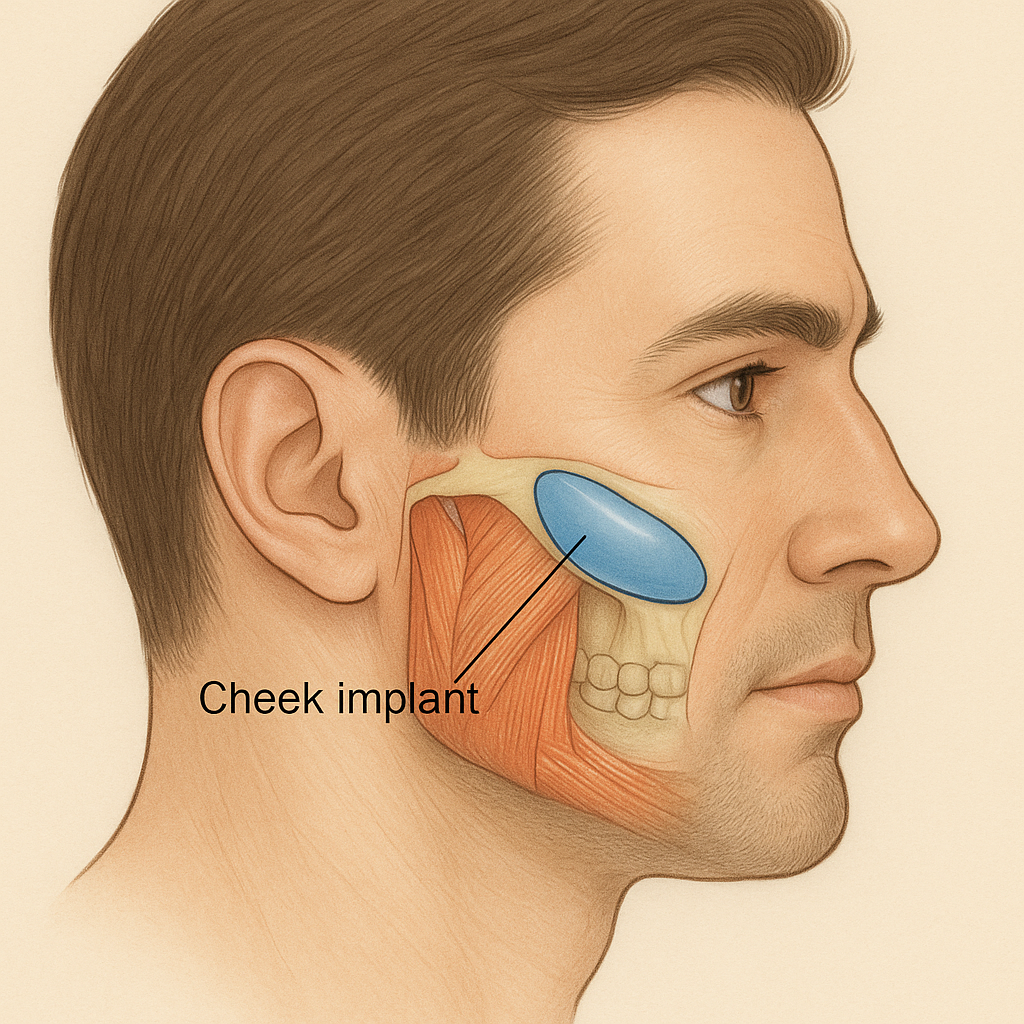
What is cheek prosthesis surgery?
Cheek augmentation surgery is a cosmetic procedure that uses silicone implants or biocompatible materials to increase the volume of the cheeks and improve facial symmetry and prominence. This surgery helps people with flat, hollow, or sagging cheeks achieve a more youthful, balanced, and attractive facial shape.
Reasons for cheek prosthesis
Highlighting cheekbones and shaping the face
Compensating for decreased cheek volume due to aging or weight loss
Improving facial symmetry and balance between its components
Permanent alternative to repeated filler injections
Increase self-confidence and improve mental image of the face
Benefits of Cheek Prosthesis Surgery
Long lasting: Unlike fillers, it has a stable and long-lasting result.
Natural result: If you choose the right size and location, the result will look completely natural.
Reversible: If you are not satisfied, you can remove or replace the implant.
Increasing facial symmetry: especially for people with structural asymmetry
Adding volume to the midface: especially in people with hollow or sagging cheeks
Types of cheek implants
1. Solid silicone: The most common option; soft, flexible, biocompatible, and removable
2. ePTFE (Expanded Polytetrafluoroethylene): Allows natural tissue to grow into the implant for greater stability
3. Custom implant: Designed based on a 3D scan of the patient’s face for specific corrections or congenital abnormalities
4. Fat Grafting: A natural alternative that uses the patient’s own body fat, but it is less durable than implants.
Cheek prosthesis surgery steps
Consultation and evaluation: Facial structure examination, symmetry check, implant type selection, and detailed surgical planning
Preparation before surgery: stopping blood thinning medications, avoiding smoking, maintaining oral hygiene if an incision is made inside the mouth.
Anesthesia or anesthesia: Usually general anesthesia or local anesthesia with sedation depending on the patient’s condition.
Creating a cut:
Through the mouth (without external scarring)
Or through the lower eyelid (if combined with other surgeries such as a lift)
Implant placement: The implant is placed and secured in the upper layer of the cheekbone in the space under the muscle.
Sutures and dressings: Sutures are usually absorbable, and a light dressing is used to reduce swelling.
Post-surgery care
Using cold compresses to reduce swelling
Sleeping with your head elevated
Avoid chewing hard foods for the first week.
Strict oral hygiene in case of internal incision
Avoid touching or pressing on the cheek area.
Taking prescription medications, including painkillers, antibiotics, and antiseptic mouthwashes
Recovery period
Return to light activities: 7 to 10 days
Main swelling reduction: 2 to 3 weeks
Final result and final shape of the cheek: about 6 to 8 weeks
Possible complications
Swelling and bruising of the cheek area
Temporary numbness or a feeling of pressure in the face
Infection at the suture site (rare)
Implant relocation
Asymmetry if not placed accurately
The edge of the implant can be felt or seen in very thin skin.
Who are suitable candidates?
People in good general health
People with flat or hollow cheeks
Those who have realistic expectations
Non-smokers or those ready to temporarily quit smoking
Those who have enough skin and muscle to cover the implant
Frequently Asked Questions
Are the results permanent?
The results are long-term and the implants are very durable, but can be removed if needed.
Does the implant not cause sagging of the cheek?
No, if it is placed correctly in the appropriate layer, it not only does not cause sagging but also causes a natural lift of the area.
Can the implant be felt?
If properly selected and with adequate tissue coverage, the implant cannot be felt or seen.
Can this surgery be combined with other facial procedures?
Yes; cheek augmentation is usually combined with rhinoplasty, facelift, or eyelid surgery.