


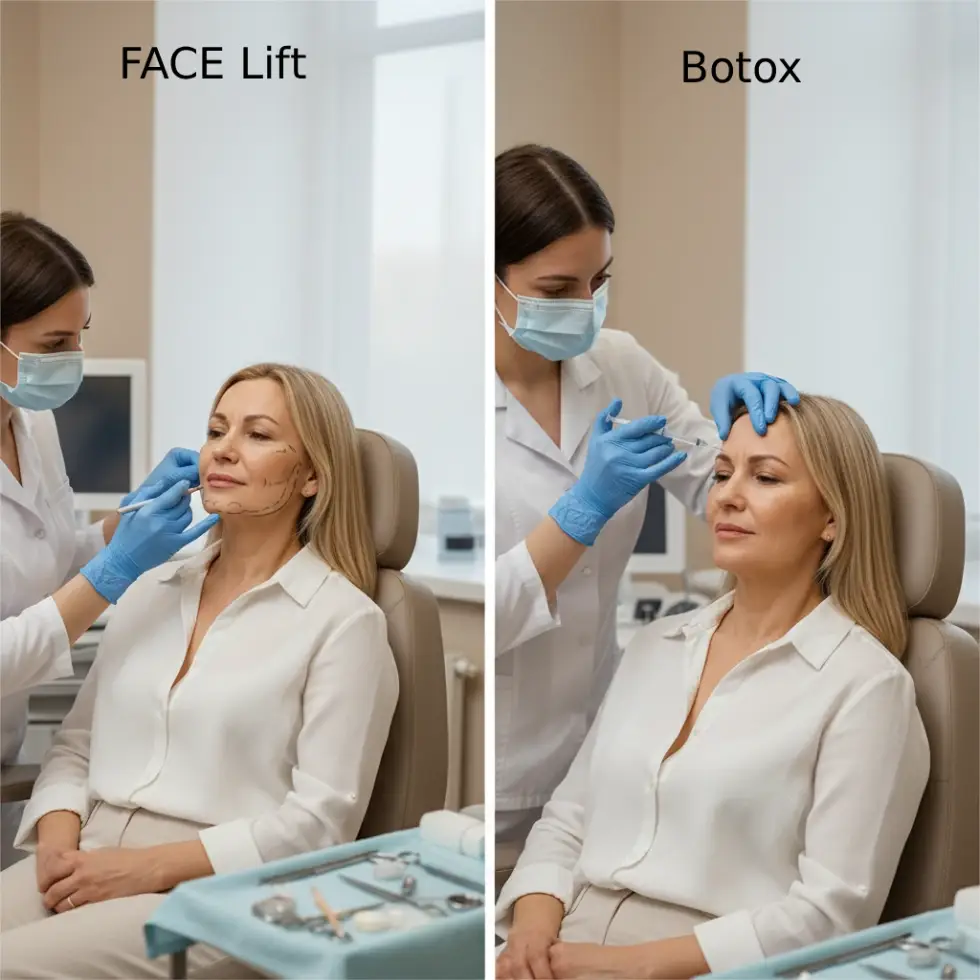
Aging, collagen loss, muscle relaxation, and sun exposure are the most important factors that cause sagging and wrinkles on the face. Today, there are many different methods for facial rejuvenation; but among all these techniques, facelift and Botox are two very popular methods that patients always ask about their differences and the effectiveness of each when they visit a specialist.
Many people think that facelifts and Botox have the same function or are alternatives, while these two methods have different uses, duration, effectiveness, and results. The choice between these two methods is made correctly when a person knows exactly what the advantages and limitations of each one are.
In this article, we will comprehensively explain, in simple and highly specialized language, the differences between facelift and Botox, their uses, duration, possible side effects, and in which situations each is better, to make the choice easier for you.
What is a facelift and how does it work?
A facelift is a rejuvenation technique whose main goal is to lift and tighten sagging skin, tighten deep tissues, and reduce facial sagging .
Facelifts are divided into two general categories:
Facelift Surgery
Non-surgical facelift (non-invasive or minimally invasive such as thread lift, hypnotherapy, RF, etc.)
In this article, we will focus more on the non-surgical facelift because it is often compared to Botox.
Thread lift
This method uses special medical threads that are inserted into the skin and tighten the tissues, removing looseness. These threads gradually stimulate collagen production.
Hypnotherapy
This method uses high-energy ultrasound waves that heat the deep layers of the skin, tightening the skin and stimulating collagen production.
Fractional RF
This method uses radiofrequency energy to heat the deep layers, causing gentle lifting and tightening of the skin.
Key Benefits of a Facelift
Reducing sagging and sagging
Gentle angulation
Stimulation of collagen production
Longer lasting than Botox
Suitable for moderate to severe sagging
What is Botox and how does it work?
Botox is a drug injection that temporarily relaxes the muscles that activate wrinkles . It is most effective on dynamic wrinkles , which are those that form when you laugh, frown, or smile.
Botox is very common for the following areas:
Forehead lines
Frown lines
Crow’s feet lines around the eyes
Sad lines at the corners of the lips
Slight eyebrow raise
Botox has no effect on sagging skin, facial laxity, deep lines, or volume , and should not be considered a substitute for a facelift.
Benefits of Botox
Quick and easy treatment
No recovery period
Control of movement lines
Suitable for younger ages
Lower cost than a lift
To see the Botox results of our clients in pictures, we suggest you visit Dr. Reza Moeini’s Instagram page .
The most important differences between a facelift and Botox
The difference between a facelift and Botox is not only in the way they are performed; there are also fundamental differences in the philosophy of operation, durability, effectiveness, suitable groups for treatment, and even the final results. Understanding these differences helps people make a more accurate choice based on their real skin needs and beauty goals.
1. Difference in mechanism of action
Botox works by inhibiting muscle movement . Simply put, botulinum toxin weakens or immobilizes the muscles that cause frown, laugh, and forehead lines by reducing nerve signaling. By reducing movement, the skin has a chance to smooth out and fine lines and wrinkles disappear.
But a facelift, whether through non-surgical methods such as threading and hypnotherapy or surgery, focuses on rebuilding the subcutaneous structures . In this method, the muscles are neither immobilized nor muscle contraction is reduced; rather, the goal is to tighten and strengthen the skin, stimulate collagen production, and restore the lost shape of facial lines . Therefore, its effect is deeper and more structural than Botox.
2. Differences in the type of wrinkles targeted
Botox is for dynamic wrinkles , meaning lines that are created by muscle movement. For example, frown lines, forehead lines, and crow’s feet lines around the eyes are the areas that respond best to Botox.
In contrast, a facelift works best on static wrinkles and sagging skin . These lines are visible even when the face is at rest and are caused by sagging skin, reduced subcutaneous fat, and sagging tissues. Therefore, wrinkles around the mouth, jawline, double chin, sagging cheeks, or sagging neck skin are the main targets of a facelift.
3. Difference in speed of results
Botox is one of the fastest cosmetic treatments available. Initial results are usually visible 3 to 7 days after injection, with peak results occurring within two weeks.
But facelifts vary in speed depending on the procedure.
In thread lifts, the initial results are almost immediate, but the final results are visible in a few weeks.
In hypnotherapy, the results are gradual and are complete in 2 to 3 months
. In surgical lifts, there is also initial swelling and it is necessary to wait a few weeks to see the final results.
4. Difference in durability
Botox usually lasts for 3 to 6 months , as the muscles gradually regain their strength and there is a possibility that the lines will return.
Facelifts, especially the more advanced ones, last much longer.
A thread lift lasts about 1 to 2 years , HIFU lasts 6 months to 1 year , and a surgical lift lasts even 7 to 10 years . This difference in longevity is one of the main reasons why some people choose a facelift over a more radical option.
5. Differences in invasiveness and recovery period
Botox is a completely non-invasive procedure . The injections are superficial and the patient can continue their daily activities immediately after the injection.
Facelifts vary in their level of invasiveness, depending on the procedure.
HIFU and RF are non-invasive and do not require downtime.
Thread lifts, however, are a bit more invasive and require a day or two of care.
Surgical lifts are the most invasive, with a recovery period of 2 to 4 weeks .
6. Difference in the amount of change in appearance
The result of Botox is a subtle, subtle change . The face only appears smoother, younger, and wrinkle-free, but it does not change the overall shape of the face.
In contrast, a facelift can produce noticeable changes in cheek shape, jawline, chin area, and skin volume. This difference makes a facelift a better choice for people looking for a “dramatic” facial transformation.
7. Differences in the appropriate age to perform
Botox is usually best suited for people between the ages of 25 and 45 , as it works best on early wrinkles.
But a facelift is suitable for people aged 35 to 65 ; that is, when skin sagging has increased and there is a need for structural intervention.
8. Difference in costs
Since Botox is less durable, it is also less expensive and requires renewal.
A facelift costs more but its effects last longer and can be more economical overall.
In what situations is a facelift better?
If you have one or more of the following, a facelift is probably a better option:
Sagging cheeks
Loose skin of the jaw and jawline
Double-breasted
Jaw angle reduction
Deep lines around the mouth
Reducing cheek prominence
Decreased skin firmness
A facelift is very effective for structural correction and restoring facial shape.
People who have experienced “tissue displacement” with age usually do not see results with Botox, but they benefit from thread lifts or HIFU.
In what situations is Botox better?
Botox is a good choice if your problem is one of the following:
Frown lines
Forehead lines
Wrinkles around the eyes
Slight eyebrow raise
Prevention of deep wrinkles
Botox is not suitable for correcting sagging, but rather for reducing movement lines.
Does a combination of facelift and Botox give the best results?
In many cases, cosmetic specialists recommend that a facelift and Botox be performed together because the two procedures have complementary functions.
Their combination:
It also reduces movement lines.
Corrects sagging and loose skin
Increases both the durability and beauty of the result
This combination is especially popular with people aged 30 to 55.
Possible side effects of facelift and Botox
All cosmetic procedures, although low-risk, are not without complications.
Possible complications of non-surgical facelift
Temporary bruising or swelling
Skin sensitivity
Temporary asymmetry
Mild pain
Possible side effects of Botox
Mild drooping of the eyelid (if injected incorrectly)
Headache
Mild swelling
Temporary facial dryness
By performing these procedures with a specialist, the likelihood of complications is very low.
Facelift or Botox: Which is better?
In fact, it cannot be said that one is better than the other because they have different uses.
If the main problem is sagging → a facelift is better.
If the main problem is movement lines → Botox is more suitable.
If you have both wrinkles and sagging → combining both gives the best results.
So choosing the right method depends entirely on the type of problem, age, face shape, and expectations of the patient .
Conclusion
Facelifts and Botox are both very effective methods of facial rejuvenation and beautification, but they have different uses. Botox is very suitable for reducing movement lines and has a shorter duration, while facelifts are recommended for removing sagging, loose skin and restoring a youthful face shape and have a longer duration.
The best choice is possible when a person knows exactly what changes they want to make to their face. A cosmetic surgeon will recommend the best method or combination of methods by examining their physical condition, the degree of sagging, and the type of wrinkles.
If you are interested in the world of beauty and skin health, visit Azargah magazine and take advantage of its practical and specialized content.